
Every time a big Pokémon TCG release drops, the same thing happens. Prices go up, stores sell out, and suddenly every marketplace is full of “mint” cards at prices that look a little too friendly. A surprising number of those are fake Pokémon cards.
With the 30th Celebration products and Mega Evolution: Delta Reign hitting stores on November 6, it’s that time again. Also, fake Pokémon cards aren’t the obvious junk they were ten years ago. Some of them are good enough to fool you at a quick glance, especially through a phone screen.
So here are the 9 checks I go through before I buy. Most of them take seconds, so there’s no excuse to skip them.
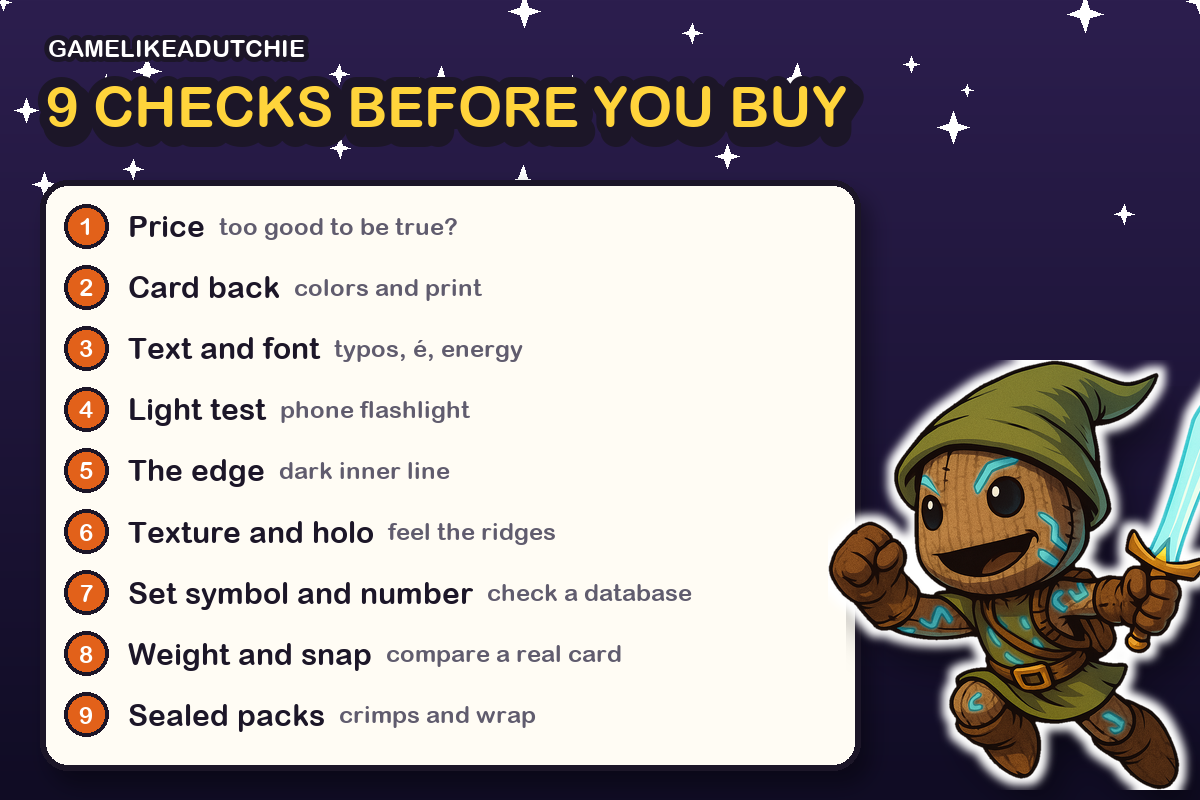
1. The price is too good
Start here, before you even look at the card. If a chase card is listed way under the going rate, ask yourself why. Look up the real price on Cardmarket or TCGplayer first. Someone selling a hot illustration rare for a third of its value is either clueless or selling a fake, and it’s almost never the first one.
2. Check the back of the Pokémon card
The back is where a lot of fake Pokémon cards give themselves away. For example, on a real card, the blue swirl has deep, rich shades and the Poké Ball sits clean in the middle. Fakes often have a back that’s too light, too purple or a bit blurry. Also, the borders can be uneven.
The best trick is to put the card next to one you know is real, because then you’re not relying on memory. The difference jumps out much faster when you compare.
3. Read the text and the font
Counterfeiters are usually bad at typography, so look for:
- A font that looks slightly off, too thin or too bold
- Spelling mistakes in attacks or descriptions
- “Pokemon” without the accent on the é
- Energy symbols that are the wrong size or sit weirdly on the line
- HP numbers that look stretched
One typo is enough, since real cards go through a lot of proofreading.
4. Do the light test
Turn on your phone flashlight and hold the card in front of it. Real Pokémon cards have a dark layer inside that blocks most of the light. On the other hand, a lot of fake Pokémon cards let the light shine right through.
Still, it’s not 100% reliable on its own. Some real cards from certain print runs let a bit more light through than others, and better fakes now copy the inner layer. So again, compare with a card you know is real, from the same era.
5. Look at the edge
Hold the card sideways and look at the edge, ideally with a magnifier or your phone’s zoom. Real cards usually show a thin dark line in the middle, which is the same inner layer from the light test. Many fakes, however, are just white all the way through.
6. Feel the texture and check the holo
Modern full arts, ex cards and illustration rares have a texture you can feel with your thumb. Think little ridges, almost like a fingerprint. Fakes, in contrast, are often completely flat and extra glossy.
Holo cards are another giveaway. On a real holo, the shiny pattern sits in the right spot and has a specific design. Fakes often have holo on the whole card, or a generic rainbow effect that doesn’t match the real one.
7. Check the set symbol, number and copyright line
Every card has a set symbol, a card number and a small copyright line at the bottom. Look the card up in the official Pokémon TCG card database or on a site like Bulbapedia and check if everything matches. If the set symbol is wrong, the number doesn’t exist or the copyright year doesn’t fit the set, you’re looking at a fake.
8. Weight and bend
Real cards have a certain feel, with a bit of snap when you flex them gently. Fakes tend to feel flimsy or, the opposite, stiff and plasticky.
If you buy a lot of singles, a cheap jewelry scale is worth it. Weigh a card you know is real from the same era first, then compare. A clear difference is a red flag.
Please don’t bend a card hard to “test” it, because you’ll damage a real one just as easily.
9. Fake Pokémon packs and boxes
Fakes aren’t just singles, though. Resealed and counterfeit packs are everywhere too. Watch out for:
- Crimps: the top and bottom seals of a real pack are even and neat, so glue, wrinkles or uneven crimps mean someone opened it.
- Shrink wrap: booster boxes and Elite Trainer Boxes usually have wrap with Pokémon logos on it, so plain, loose wrap is suspicious.
- Print quality: blurry art on the pack or colors that look washed out.
- Weighed packs: some sellers weigh packs to find the heavier ones with a hit, then sell the rest. Loose packs from a stranger are a gamble even when they’re real.
What about the rip test?
You might have seen people tear a card in half to check for the inner layer. It works, but you destroy the card. Only do this with a cheap card you already know is fake, to compare it with a real bulk card, and never on something you paid real money for.
Where to buy Pokémon cards safely
- Your local game store. Support them, and as a bonus you can check the cards in person.
- Big official retailers. Boring, but safe for sealed product.
- Cardmarket. Check the seller’s rating and number of sales.
- Vinted, Marktplaats or eBay. Fine, but ask for a short video of the card, including the back and a light test. Pick up in person if you can.
When you pay online, use a method with buyer protection, like PayPal Goods and Services. If a seller only wants “Friends and Family” or a bank transfer, walk away.
I bought a fake. Now what?
Contact the seller first and keep everything in writing. If they don’t help, open a dispute with the platform or your payment provider. Also take clear photos of the card next to a real one, front and back. Then report the listing so the next person doesn’t get caught.
FAQ: fake Pokémon cards
How can I tell if a Pokémon card is fake?
Compare it with a card you know is real. Check the back, the font, the texture and the edge, and do a light test with your phone flashlight. One check alone isn’t proof, but a few red flags together almost always are.
Does the light test always work?
No. It catches a lot of fakes, but some real cards let light through too and better fakes copy the inner layer. That’s why you should use it together with the other checks, as well as a real card to compare.
Will a grading company catch fake Pokémon cards?
Yes, because grading companies like PSA and CGC check authenticity and won’t grade fake Pokémon cards. So for expensive cards, buying graded is the safest route.
Are proxies the same as fakes?
A proxy is a printed copy for casual play, clearly sold as a copy, so that’s fine. It becomes a fake when someone sells it as the real thing.
Are fake Pokémon booster packs common?
Yes, especially loose packs online and at markets, where fake Pokémon cards show up a lot. Buy sealed product from stores you trust and check the crimps and wrap.
Final thoughts
Collecting should be fun, not a game of “did I just get scammed”. Take thirty seconds, run through these checks, and compare with a card you trust. In fact, that alone stops most fake Pokémon cards.
Waiting for the next Pokémon game while you sort your binder? Here’s everything we know about Pokémon Winds and Waves.
Ever been burned by a fake? Tell me how you found out in the comments. It might save someone else some money.
Leave a Reply